


Picture this: you come across an online news headline, one that grabs your attention right away. You don’t just want to read this article, you have to read this article. It could be about anything; the point is, you have to learn more. So you click on the link.
And then you run into a paywall.
“Continue reading with a subscription,” the pop-up tells you, blocking the rest of the article. “Only $3.99 a month.”
You now have two options. You could sign in and subscribe, pay the $3.99 a month or however much it is, or you could suddenly lose interest and click off.
Most of us would choose the latter. The problem is, news has never been free. If we expect journalism to cost nothing, we rob ourselves of being truly informed. Good journalism is worth paying for.
Stop the presses
Back in the day, newspapers were all in print. If you’ve watched old movies you’ve probably seen a character walking down the street at night, pausing to buy a paper from a newsstand with a nickel.
The news wasn’t free then, and it isn’t now. Journalism has always been important. The freedom of the press is written into the first amendment of the constitution.
For decades, it was common knowledge that if you wanted good journalism, you had to pay for it. That all changed with the advent of the internet.
News began to be published digitally, and news sites began to publish their content for free. News became readily accessible, but it also conditioned people into believing that they could just get news for free.

“Newspaper revenue has been in decline for decades, and most Americans now prefer to get news from digital devices,” reported the Pew Research Center. “In this environment, many news organizations – and not just newspapers – put paywalls on their websites or apps, blocking access to articles or other content unless news consumers pay or subscribe.”
With most news having gone digital by now, they’ve had to find other ways to make sure people pay for their services. For example, the Salt Lake Tribune limits readers to two free articles a month– unless they subscribe. News sites use paywalls to ensure that you pay for their services.
“There’s no question that news is worth paying for, because is democracy worth paying for?” said Lane Williams, journalism professor at BYU-Idaho. “When news is done well it’s not entirely cheap, and when it’s done well, it improves democracy, and sometimes you don’t even realize it.”
Williams earned a PhD in journalism from the University of Maryland and worked for Deseret News before becoming a professor at BYUI. Williams said that journalism is important because it makes democracy possible.
News was historically funded by subscriptions and advertisements, but in recent years many news sites, with exceptions like the Wall Street Journal, started putting their content for free online.
“When the internet came out journalism, for whatever reason, decided to make its content free,” Williams said. “Once people said it should be free early on in journalism, people don’t want to now start paying for it. I also don’t think that people understand the value because it’s just there. News in a way is so ubiquitous, it’s like the air we breathe.”
Pew Research reported that overall, 83 percent of Americans say they have not paid for news in the past year.
According to Williams, many of us are willing to pay for lots of subscriptions, but not for the news. According to Forbes, people spend an average $77 a month on streaming subscriptions.
“After you’re used to getting something for free, and there’s other free sources, people don’t want to pay for it,” Williams said. “But it’s an irony, because you’re willing to pay for Spotify, you’re willing to pay for entertainment. What about news?”
Getting hit with a paywall leaves the reader with two options: pay for news, or find some way to circumvent it.
The numbers
According to Pew Research, 74 percent of people say they have run into paywalls “at least sometimes” when viewing news online. 38 percent say they run into them often or extremely often.
Not all news websites have paywalls though, according to Pew Research, who lists examples like the Salt Lake Tribune and Los Angeles Times as news sites that have loosened paywalls or are in the process of doing so.
“Others have recently loosened paywalls or removed them for certain content like public emergencies or public interest stories,” Pew Research said.
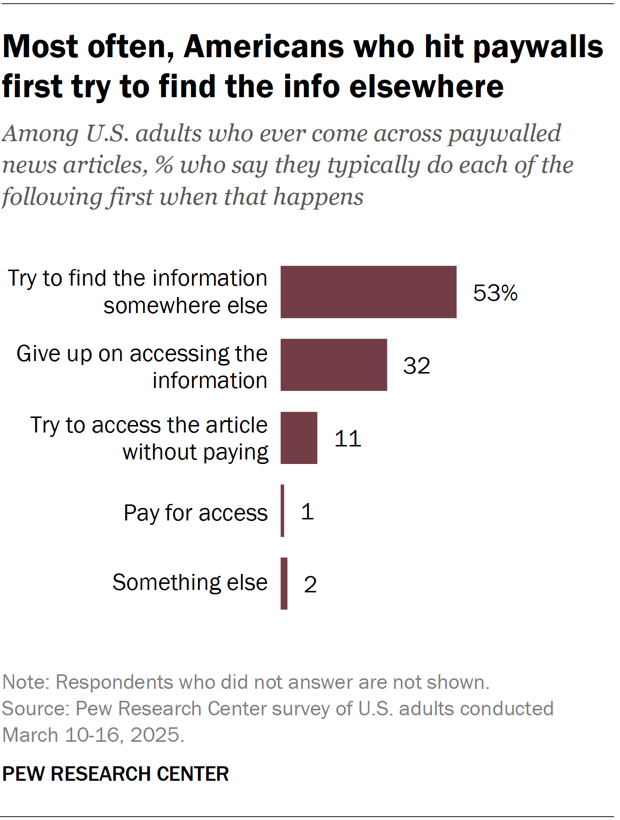
When encountering a news paywall, Pew Research reports that 53 percent of people try to look for the information elsewhere. Possibly the most telling number is that only one percent pay for access right away.
One could deduce that paywalls simply don’t work, but according to Williams, some news sites have still been able to profit. They have to convince their audience that what they have is worth paying for.
“Part of the argument of a paywall is you really need to provide something that people are willing to pay for,” Williams said. “One of the reasons the Wall Street Journal has been successful is [if] you’re a businessman, there’s stuff in the Wall Street Journal that help you make money, so you’re willing to pay for that because it helps you make money.”
Williams said that there are a few things that journalism could do to adapt, such as using nonprofit news organizations like Report for America or possibly approaching media companies to add news into subscription bundles, but he hasn’t seen that so far.
“There are a lot of ways that journalism could be funded that journalism organizations have not done,” Williams said. “It’s the fault of the journalism publishers, the business guys behind journalism. We as journalists want to get our stuff out there, but people don’t pay for it and it’s very frustrating.”
If more than half of everyone who encounters paywalls goes somewhere else for the information, it seems that it just isn’t effective enough.
According to Williams, this lack of desire to pay for news is fueling the partisan bias we tend to see, and that quality journalism is the stuff you don’t get for free.

“People complain about how partisan the news is. That’s because of how we fund it, because we fund it through clicks, and what people want to click are controversial,” Williams said. “That’s reality, and so you make something for clickbait. You don’t know what quality news is until you don’t have it anymore.”
Having news readily available on social media without subscription charges presents the idea to people that news is free. Forty-nine percent of people say that they don’t pay for news because “they can find plenty of other news articles for free," according to Pew Research
“There’s become an assumption that if it’s important, it’ll find me,” Williams said. “But of course, it doesn’t. So really good journalism is expensive, the good news is; journalism is better than it’s ever been.”
But that's not the only reason why people aren't paying for news
How much do I owe ya?
The price of news is not constant. According to the Poynter Institute, reporting from a study conducted by the Reuters Institute for the Study of Journalism at Oxford University, the median cost of online news is $16 a month.
Pew Research said that 10 percent of people who don’t pay for news say it's because it’s too expensive. That all depends on which news outlet we are looking at, so let’s compare some prices.
The Salt Lake Tribune, as mentioned before, restricts viewers to two free articles a month. To bypass this, one would need to pay a monthly subscription fee of $10.
Meanwhile, the New York Times current offer allows people to subscribe for $1 a week, or $4 a month. This price will increase after the first year, and this subscription also allows full access to the New York Times games, like Wordle and Crossword.

Meanwhile, the Wall Street Journal is $4 a week for the first year, with the premium subscription at $7 a week. Much like the New York Times, this will also increase after the first subscription year elapses. (It’s also worth pointing out that BYU-Idaho students have full access to both the New York Times and the Wall Street Journal through the David O. McKay Library.)
Reuters and The Atlantic are two well-regarded national news organizations. A Reuters subscription is $1 a week, or $45 for a year. The Atlantic offers two options: $79.99 a year or $89.99 a year for print and digital access. The digital-only cost comes to just under $7 a month, which is about the same as the student plan for Spotify Premium.
Finally, the Idaho Statesman offers two plans. The first is $1.99 for the first month, after which the cost is $15.99 a month. The other option is 44 cents a day, or $159.99 annually.

These news organizations are all different–the Salt Lake Tribune, for example, is a non-profit group. Each one will have something different to tell you, and if you want full, unrestricted access, you’ll have to pay.
Losing faith
Another reason why people choose not to pay for news is because they don’t trust it. Pew Research reported that 32 percent of people said they are not interested while another eight percent said the news was not good enough to pay for.
According to a Gallup poll from October 2024, 36 percent of Americans have no trust in the media at all. Meanwhile, 33 percent say they have “not very much” confidence in the media to "report the news 'fully, accurately and fairly.'"
That’s a significant number of Americans who don’t trust the news and tend to avoid it altogether.
“Past Reuters reports have made headlines with findings of a lack of trust in news media (especially in the United States) and news avoidance by more than a third of adults because many find journalism polarizing or depressing,” Poynter reported.
This factor, combined with the perceived high cost of news subscriptions, explains why paywalls for online news tend not to make much of a difference.
But with the news, sometimes you get what you pay for.
Follow the money
In this digital age, profits for news outlets are increasingly being driven by ad revenue. The Seattle Times say that they depend on ad revenue, encouraging readers to disable ad blockers so they can keep their subscription prices low.
Digital ad revenue is increasing, not just for the news. Digital advertising in the United States has grown exponentially over the past couple of years. Pew Research reported in 2023 that digital ad revenue grew to $245 billion in 2022 with nondigital advertising at $96 billion.
Some news sites, like East Idaho News, don’t ask for subscribers (though they do take donations) but do use ads.
It’s a way for news sites to have to rely less on subscriber revenue which, as Pew Research reports, 83 percent of Americans don’t pay for. Digital ads guarantee revenue.
Still, digital ads aren't enough, and news sites need subscribers to provide consistent revenue. Simply put, if we want journalism to survive we need to financially support fair, trustworthy news sites.
Why is journalism important?
Journalism plays a vital role in keeping society informed and keeping democracy healthy . The Society of Professional Journalists Code of Ethics states that journalists must seek the truth and report it. This search for and distribution of truth is why the news is important.

Williams suggests that in order to stay informed, people should subscribe to one or two publications and look into nonprofit news organizations as well.
“Every student on this campus should be using the free subscription they’re getting to the Wall Street Journal through the library,” Williams said. “The University spent thousands and thousands of dollars for that. Do the same thing with the New York Times.”
We have a responsibility to stay informed, and that’s why we need to know what’s going on. That’s what the news does for us.
“Find the good quality stuff, just do what you can, contribute, pay,” Williams said. “Be part of the solution, not part of the problem. Don’t succumb to clickbait, if you find a quality source, go back to it.”

0 Comments